 Voyage to Paradise
Ancient Times
The Indonesian archipelago has been inhabited for millions of years. Fossilized remains of Pithecanthropus Erectus — commonly known as “Java Man” — were discovered on Java by scientist Eugene Dubois, dating back 500,000 to 2 million years. This makes Indonesia one of the earliest known locations of human habitation.
Buddhist and Hindu Kingdoms
From around 100-200 AD, Buddhist and Hindu influences arrived from India, laying the foundations for a series of powerful kingdoms that would flourish for over a thousand years.
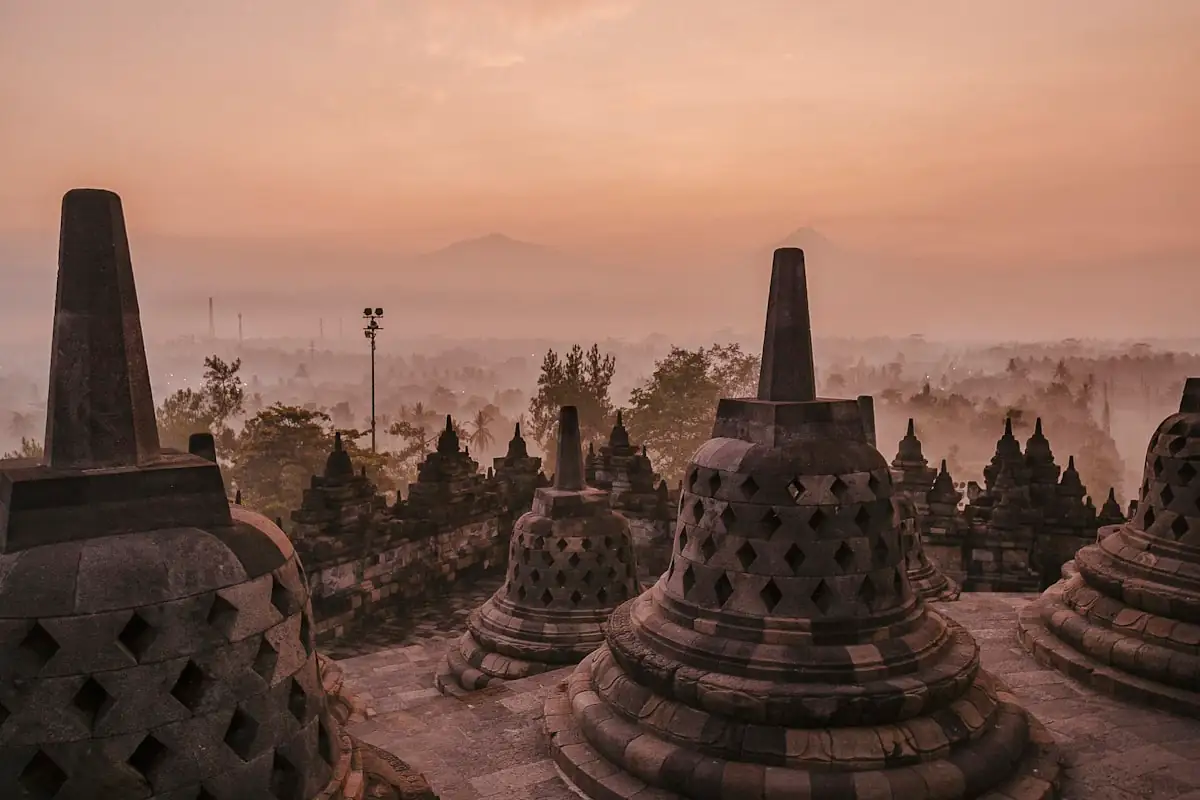
One of the most famous was the Sailendra dynasty (750-850 AD), during whose reign the magnificent Buddhist temple at Borobudur was constructed — today the largest Buddhist monument in the world. The subsequent Hindu kingdom of Mataram continued the tradition of grand temple building, including the Prambanan complex.
The mightiest of all was the Majapahit Empire. Under King Hayam Wuruk (1331-1364 AD), the empire’s influence extended as far as Vietnam, Cambodia, and the Philippines, making it one of the greatest empires in Southeast Asian history.
Islam Arrives
In the 13th century, Gujarati and Persian merchants brought Islam to Indonesia’s coastal areas. The new faith gradually spread across the archipelago, reaching the Sultanates of Bone and Goa in Sulawesi, Ternate and Tidore in Maluku, and into Banjarmasin, Palembang, Minangkabau, Pasai, and Perlak. By the 15th century, Islam had become the dominant religion across much of the archipelago.
European Period
European influence began when the Portuguese arrived in 1512, searching for spices. Both Portuguese and Spanish missionaries spread Christianity. In 1602, the Dutch established the Dutch East India Company (VOC) to control the lucrative spice trade. After seizing Ambon (1605) and Banda Island (1623), the Dutch held a monopoly over the “Spice Islands.”
During the Napoleonic wars, when Holland was occupied by France, Indonesia briefly came under British rule. After Napoleon’s fall, the Dutch regained control in 1815 through a convention with Britain.
Throughout colonization, Indonesians continuously fought for independence. This struggle, begun in the 1600s, would finally reach its climax in the 20th century.
Independence
When World War II broke out, Japan occupied the Dutch East Indies in March 1942. Three years later, when Japan surrendered to the Allied Forces on August 14, 1945, Indonesian leaders saw their moment.
On August 17, 1945, Soekarno and Dr. Mohamad Hatta proclaimed Indonesia’s independence. The proclamation was broadcast nationwide through a captured Japanese radio station, and an English translation was transmitted overseas soon afterward. This date is celebrated every year as Indonesia’s Independence Day.